 Chat to Order

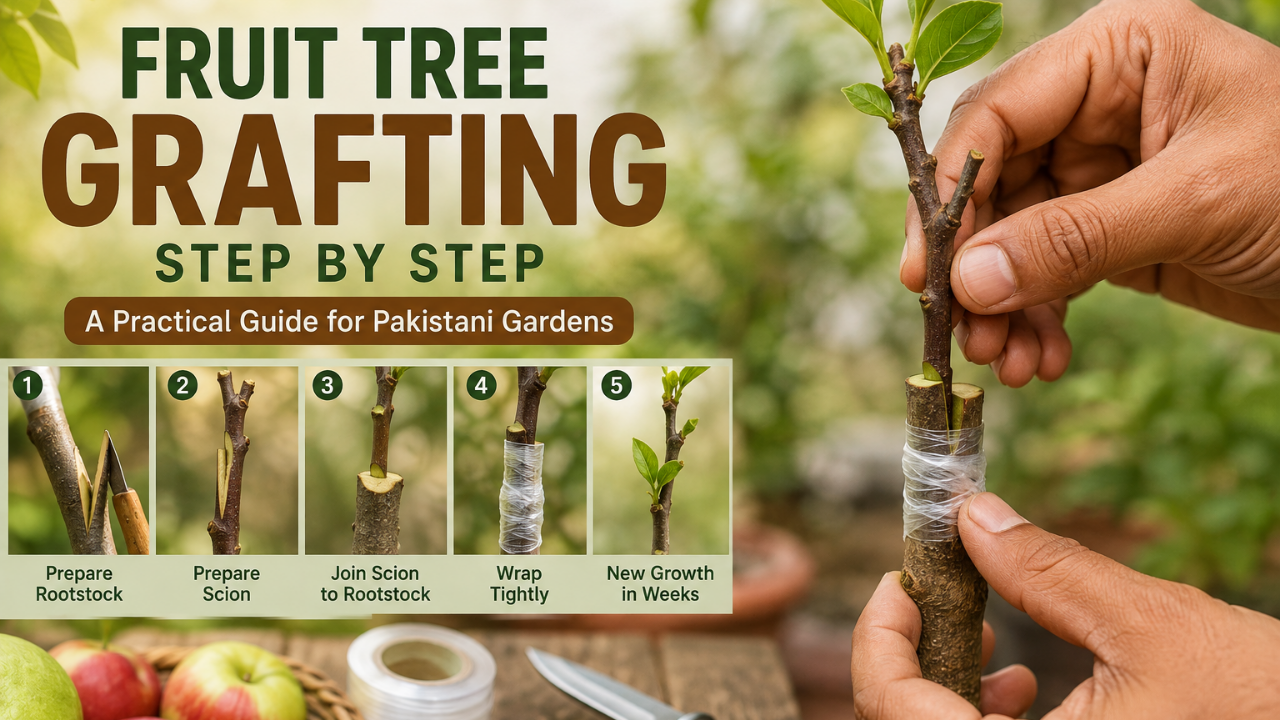
Fruit Tree Grafting Step by Step: A Practical Guide for Pakistani Gardens
A fruit tree grown from seed can take eight years or longer to fruit, with no promise it will taste like the parent tree. A grafted tree skips most of that wait, often fruiting within three years.
That's the whole idea behind fruit tree grafting: joining a cutting from the variety you want, the scion, onto an already rooted plant, the rootstock, so the two grow as one tree. Once you know what each cut is doing, grafting fruit trees becomes easy.
What You Need Before You Graft a Fruit Tree
Matching a Scion to a Rootstock That Will Actually Take
Grafting only works between closely related plants. Taxonomic closeness between rootstock and scion is required for a working union.
Tools and Materials for Grafting Fruit Trees
- A sharp grafting or budding knife and clean secateurs, since a dull blade crushes cells instead of slicing them.
- Grafting tape and grafting wax, to hold the union tight and seal it from drying out.
- Rubbing alcohol to sterilize the blade between cuts.
Fruit Tree Grafting, Step-by-Step Process
Once your scion and rootstock are ready, grafting a fruit tree comes down to six steps.
- Prepare the rootstock. Choose a healthy stem, pencil-thick to finger-thick, and cut it cleanly a few inches above the soil line.
- Cut the scion. Take a dormant cutting with two to three healthy buds, and slice its base at a long, sloping angle.
- Match the cuts. Cut the rootstock at a matching angle so both surfaces fit like puzzle pieces, exposing as much cambium as possible.
- Join scion to rootstock. Press the cut faces together right away, lining up the cambium on at least one side, even if stem widths differ slightly.
- Wrap and seal. Bind the union firmly with grafting tape, then seal any exposed cuts with wax so the tissue can't dry out.
- Label, water, and watch. Tag the graft with the variety and date, water as usual, and check weekly. New growth usually shows in three to six weeks.
Common Fruit Tree Grafting Techniques
Whip-and-tongue graft
This is usually the best general-purpose method for producing new fruit trees when the scion and rootstock are approximately the same thickness.
Simple whip or splice graft
A simple whip graft uses matching diagonal cuts but does not include the interlocking tongues.
Cleft graft
Cleft grafting is useful when the rootstock or branch is much thicker than the scion. It is one of the most practical techniques for top-working an established tree.
Bark graft
Bark grafting is designed for large branches or trunks where cleft grafting would require an excessively large split.
T-budding
T-budding inserts a single dormant bud from the desired variety into a T-shaped cut in the rootstock. It is widely used in nurseries because it is fast and economical.
Grafting Mango, Citrus, and Guava for Pakistani Gardens
A technique that performs well overseas doesn't always match what works best for the fruit trees grown here:
- Mango: cleft and veneer grafting both work well when timed right, with high success rates. Stone grafting onto a seedling can produce a fruiting tree in about two years.
- Citrus (kinnow, orange, lemon): bud grafting is standard, since citrus bark slips easily and a single healthy bud is enough to start a tree true to variety.
- Guava: takes well to cleft or softwood grafting onto seedling rootstock, usually done once new growth has hardened slightly.
Ready to Plant, Not Just Ready to Graft?
Grafting your own fruit trees is satisfying work, but not every first attempt survives its first winter. If you'd rather start with a tree already grafted and hardened off, Gulab.pk stocks mango, guava, citrus, and other fruit tree saplings from trusted nurseries in Lahore, Karachi, and Multan.
FAQs
What is fruit tree grafting?
It's joining a cutting from the variety you want, the scion, onto an already rooted plant, the rootstock, so the two grow as one tree that fruits true to the scion's variety.
Can any fruit tree be grafted onto any rootstock?
No. Grafting works reliably only between closely related plants, usually the same species or genus.
How long does it take for a fruit tree graft to heal?
New growth often shows within three to six weeks in warm weather, but the union needs several months to form a fully strong vascular connection.
Which fruit tree grafting technique is easiest for a beginner?
Whip and tongue grafting is usually the easiest for beginners.
Why do fruit tree grafts fail even when the steps are followed correctly?
The usual causes are poor cambium contact, incompatible plant material, wrong-season grafting, and cut surfaces drying out before the union heals.